
Data Attribution : Data referenced on this page is sourced from the Firefighter Rescue Survey © 2016 F-ODE, used under the Creative Commons Attribution 4.0 International License (CC BY 4.0). Source: FirefighterRescueSurvey.com License: creativecommons.org/licenses/by/4.0/
Time to Target
The rescue doesn’t stop when we find the victim. How we remove them matters just as much. So, the real question becomes: how are we training to get victims out, and what’s our plan when conditions (and the victim themselves) work against us?
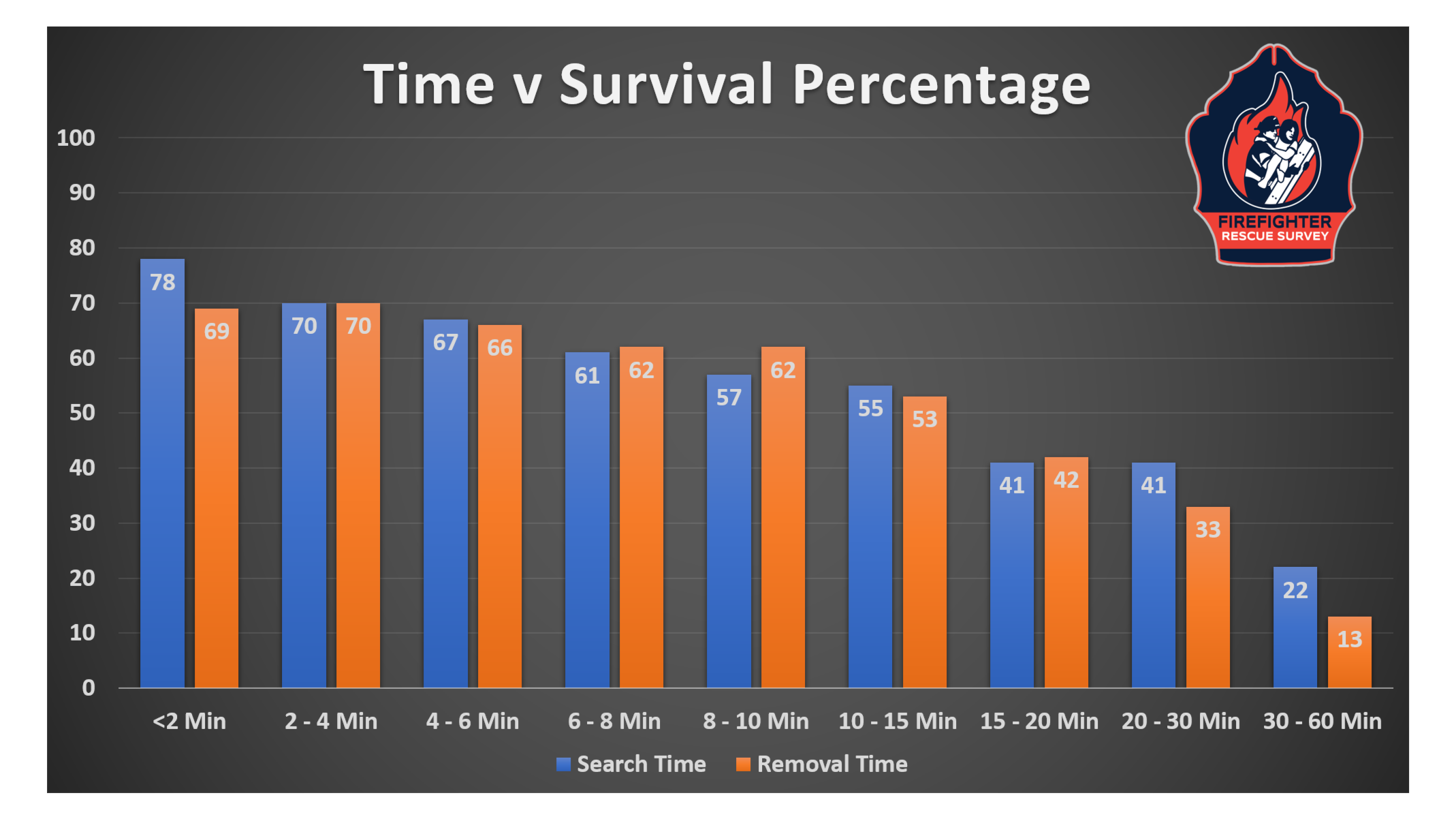
The faster we find and remove a victim, the better their chances of survival (with the goal of our victims walking out of the hospital). Departments across the country are already improving outcomes by prioritizing search and using aggressive, targeted tactics. The Firefighter Rescue Survey shows that more than half of all victims who survive are found and removed within the first two minutes of arrival—and many of those are people who can still move or assist in their own rescue.
About a third of all rescues happen between the 2–8 minute mark, and after eight minutes, survival drops sharply. Every second matters, and every delay works against the victim.
Our mission at First IN Mounts is to cut down the time it takes to both locate and remove victims. That means pushing faster, more focused searches, and just as importantly, reducing how long victims spend in IDLH conditions after we make contact. We want to eliminate needless dragging, long interior paths, or anything that slows down removal. The goal is straightforward: rapid, deliberate, and efficient victim removal that gives people the best possible chance of surviving.
The Unconventional Victim
What happens when the victim is unconventional? When the person we’re trying to rescue doesn’t fit the idealized profile we’ve trained with? What if they’re larger, heavier, unconscious, and completely unable to assist in their own rescue? The victim that is the most statistically probable for us to find when in low to no visibility conditions.
We cannot afford to let our training remain limited to the standard scenario victim. We must evolve deliberately to ensure we can rescue victims of all sizes, conditions, and circumstances with the same urgency and effectiveness.
A victim-first mentality isn’t just about finding them quickly, it’s about being fully prepared to remove any victim, under any condition, and give them the best possible chance of survival. That requires constant improvement in our tactics, tools, and mindset.
I’m not proposing a one-size-fits-all solution. What I am challenging is our collective comfort zone of ‘we will figure it out if it happens to us’. It’s time to move beyond locating victims and relying on brute-force removal methods that can delay or compromise the rescue. Instead, we must begin revolutionizing our approach to what happens after victims are found; focusing on efficiency, effectiveness, and innovation in the rescue process to decrease their mortality rate.